what is alt text & why should I use it?
Alt text is text that is linked to a specific image posted on the Internet. It’s called that because alt is short for “alternative”, and in HTML, image tags have an “alt” attribute that can be used to set the text that will load if images aren’t loading.
Today, that’s still a useful purpose for alt text — very slow connections, or people with images disabled, will still be able to see what an image is and why it’s there. People using screenreaders, or who otherwise need the text context to figure out what an image is, are also able to participate in an increasingly image-heavy web as long as there is alt text.
In short, alt text is important for accessibility! The most common case is blind people using screen readers, but many other people use alt text as well. On websites, alt text also helps web crawlers like Google’s figure out what your site is about, since they also can’t easily read images.
how might alt text be used in a fandom context?
Lots of ways. If a carrd or other personal website has icons for social media links or images that link to other pages, with no readable text (text inside images doesn’t count), they should have alt text so it’s clear what they’re for.
For fic or event graphics, often just a brief description of the image vibe plus the text that’s on the image (as long as it’s not also in the tweet — blind people don’t need to have the same text read out twice!) is all you need.
For artists, things are a little more interesting! Your art is very personal to you, and your alt text doesn’t need to be bland and professional and super detailed if that’s not the right vibe. After all, this is how some people will “see” your art — it shouldn’t be too long, but it should give them a bit of the energy they want to see.
Some questions to consider:
- Do you want to describe medium (e.g. watercolor, digital painting, digital sketch, pencil sketch)? This is often only necessary for photos/scans of physical art.
- What’s the most important thing about your art, that the viewer would immediately see or take away from it?
- Who is involved? (You don’t need to describe the characters’ appearances, since it’s fanart, unless they’re mermaids, have different hair, or something like that!) What are they doing?
- What’s the most concise way you can say this? (Some older screen readers cut off after a certain number of characters, so the most important details should go first no matter what!)
okay, tony, what’s some examples of alt text for fanart or fic graphics?
I’m glad you asked! Here’s a few examples.
art
This image was a quick doodle, and didn’t really need more of a description than this. If you’re quite a concise person in general, this is totally fine!
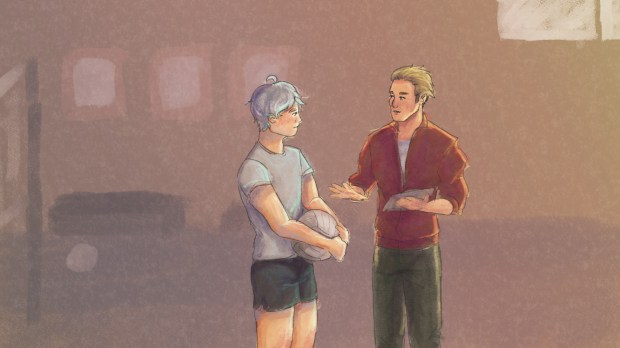
This was one of five illustrations for a big bang. I don’t know if “pensive” is what everyone would get from this image, but it’s what I wanted to communicate in context, so that’s what I chose to put in.
For this one, I wanted to describe the medium, to give a bit more of the vibe. It wasn’t quite right! I didn’t need to explain the fandom, since that was probably obvious, and there were clearer ways to reword it so the important parts came first. It’s traditional to put the medium first, but you don’t have to if that’s not the important part!
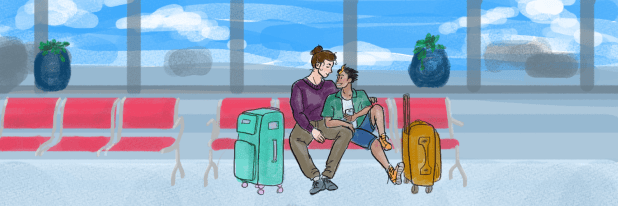
When characters are interacting, I tend to think that setting and expression/gesture are the most important things. In general, if there’s a mood you want to express, feel free to express it, either by describing gesture or explicitly!
not art
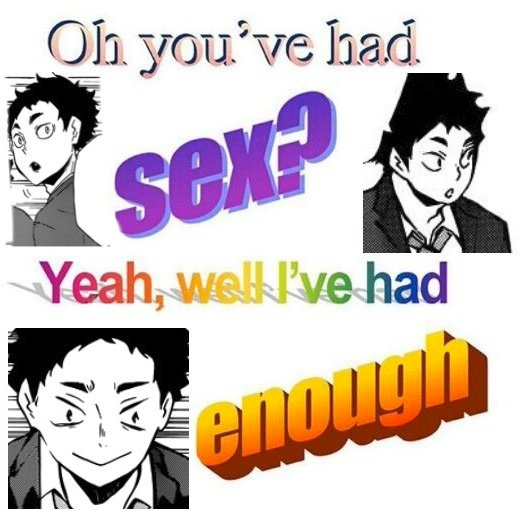
Memes can be captioned as well! If it’s a reference to an existing meme, you may prefer to just describe it as “a version of X meme with Y characters” or whatever is relevant.

If an older screen reader cut off at any point, they’d have gotten the main information in this image. The rest is a bonus, which is how I as the writer intended the image, how it feels for me, and how I hope it feels for the reader. This is true for artists too!
I do have a fanweek example, but it’s not safe for work, so I’ve linked it here. You can click on ALT on the bottom left of each image to see its alt text.
In general, this is a feature available across Twitter! Whenever you see it, you might enjoy clicking on it to see how the artist or writer has described their images.
what about non-fandom examples?
A lot of pet photo accounts have delightful alt text:
And this one is…. a must-see.
what other easy ways can we be more accessible?
If you’re running an event with an AO3 collection, you can put an accessible version of all the text from the graphics on the collection’s profile and link it! This saves you time making a carrd or other website, but more importantly, AO3 allows skins, and is likely already set up to be readable by the person who can’t read your graphics, whether for screen reader reasons or just because they (like me) have a less severe vision impairment that affects contrast, size, or complicated fonts.
On that note! Space things out, avoid super tiny text or super decorative fonts, and use a contrast checker before making graphics.
Please stop using those “decorative fonts” that let you tweet in cursive or bold. Those are mathematical or other Unicode symbols, and screen readers will read out their actual mathematical meaning, one character at a time. It’s excruciating! Similarly, you may also want to avoid using 280 emojis in a row, as the full names for those are read out one by one too.
That’s it for now! There’s lots more to consider if you’re interested, but this is the most relevant stuff!
Feel free to ask if you have questions 🙂
further reading
Note that I don’t 100% agree with either of the first two resources, but that’s because there’s a variety of styles for writing alt text! Just like your art or other writing style, it’s open to interpretation 🙂
 tony's minisite <3